|
HINT: Simultaneously
hit the [CTRL] and [F] keys to search this page for key word(s).
Natural
History
Ball Pythons, Python regius (also know as Royal Python) are a relatively small and
docile specie of snake, which are native to Western and West-Central
Africa. If you have purchased a Ball Python from a pet store, chances are it was born
in either Togo, Benin, or Ghana. They are called 'Ball Pythons'
because, when frightened, they coil around their head and into a ball.
Ball pythons are in the same scientific family as other Boas and Pythons, as such they are
constrictors. The term constrictor refers to their method of subduing food by coiling around
the intended item, a small mammal, and suffocating it. Ball Pythons prefer to live in
areas of mixed grassland and trees (savanna), and are active at night (nocturnal). They hunt
at night with the help of their labial heat pits×, and their Jacobson's
Organ×. During the day, they spend their time hiding in
underground rodent burrows or termite mounds.
The average hatchling is about 16-18 inches long, and adults
can pretty easily reach 36-48 inches. In captivity they can live up to about 50 years,
but 20-30 years is probably more likely. Unfortunately due to the pressures of habitat
fragmentation and destruction, as well as commercial collecting for the pet trade, skin trade,
and the killing for food, Ball Pythons in the wild do not live as long. "It (Python regius)
is considered a threatened species and permits are required for its legal export, living or
dead." (J. Mehrtens, ca.1987)

General Information
Do Ball Pythons, Python regius, make good pets? I'd have to say yes, but like most other
animals, they can be challenging at times. Before you consider getting a pet snake, you
might be interested in reading "Keeping a Snake as a Pet."
This excellent article was written by Dana Payne, a keeper at the Woodland Park Zoo, Seattle Washington.
Ball Pythons can be good 'beginner' snakes, if you follow a few caveats and know what you
are buying. One thing that you should know, is that getting the snake setup in a secure
cage will probably cost as much, if not more, than the snake itself. You will need a cage
(typically an aquarium), a secure lid, at least one heat source (either a heat mat, or an
aluminum type clip lamp), a thermometer, a water bowl, and at least one hide box. I would
suggest you also get a lamp timer, an extra hide box or two, a hygrometer (humidity gauge),
a second heat source, a snake hook, and a pair of hemostats×. You will
also need to know where to get food for your snake (or be able to
raise your own), and know of a qualified reptile veterinarian in your area.
So you've done the research and decided that you are ready to care for a snake. Now the
question is, where to get it? The easiest place to get a pet snake, would most likely be
a pet store. As typical with life, sometimes the things that come easy aren't necessarily
the best. Unfortunately Ball Pythons are not commonly bred in captivity, which means that
most of them seen in pet stores originate from the wilds of Africa.
If you do some research and find a herpetological (or herpetocultural×) society in your
area, you may be able to find someone who breeds them. If you do get your snake from a pet
store, hatchlings (16-18 inches) usually adjust to captivity. Wild caught adults
(36-48 inches) however, typically do not fare very well in captivity, due to a host of
health problems.
Once you have your snake and got him/her set up at home, the best thing to do is leave it
alone for at least a week or two. This will give your snake time to get comfortable in
it's new home. A snake that is not stressed and acclimated will eat, and generally be a
better pet. After you've patiently waited a few weeks, I would try and feed it it's first
meal See Feeding Strategies. Once it eats a few times for you,
it's OK to start handling your snake for short periods of time. I feel it's better to get
them out of the cage with a snake hook×. Ball Pythons do not usually
bite, but if a bite is going to happen, reaching your hand into the tank is typically when it
does. The snake may not know your intentions and see you as a predator or confuse you with a
food item. Bites very rarely happen, and fortunately do not hurt any worse than getting a
shot from the doctor. Once you've had your snake for awhile you will be able to "read" it
based on it's body posture and activity cycles. For the most part, hatchlings may tend to
be a little more defensive and/or hungry, and adults are typically very docile.
Housing
For Your Snake
Housing is basically something in which you can keep your snake secure
and safe. Good caging means you can provide correct heat/light cycles and NOT provide a
means of escape for your snake. It can be simple like a Rubbermaid or Tupperware brand
sweater or shoe box with air holes in it. More popular cages are usually modified aquariums.
These do not have to be expensive. Since most people only see the value of an aquarium if it
holds water, you can sometimes pick them up at garage sales. Small Ball Pythons
(16-28 inches) will do pretty good in a ten gallon size enclosure (20x10x12 inches).
An absolute minimal cage for an adult Ball Python (30-48 inches) would be a long twenty
gallon (30x12x12 inches). A long thirty gallon (36x12x18 inches) would of course be preferred.
Securing your snake in an aquarium does not have to be a challenge or too expensive.
Pet stores will sell you screen lids which work fine, but I like to make my own.
You will need 3/4 x 3/4 inch wood molding (for 10 gallon tanks) or 1 x 2 inch boards
(for bigger tanks), some 1/4 inch hardware cloth, some screws, some wood staples, and
maybe some angle brackets. Most hardware stores sell the heavy duty screen material,
known as hardware cloth. An hour or so of cutting, screwing, and stapling and you can
construct a strong screen top like the one in this picture.
To hold it down on the tank you can either use some weight (For SMALL snakes only, I like
ceramic floor tiles), or better yet you can strap it down. Straps are as easy as getting some
belt material and buckles, from the fabric section of your local
Wal-Mart/K-Mart type store. You will end up with something which looks similar to
this.
Other options to providing safe housing for your snake would be to purchase a commercially made
reptile enclosure. More and more pet stores are selling "Lizard Lounges," which are aquariums
with sliding screen lids. Neodesha cages (a product of Bush Herpetological Supply
- off site) and
Vision Herpetolgical (off site) are two well known and respected caging products.
Heat can be safely provided in a few different ways, either a heat mat,×
and/or a clip type lamp with an aluminum reflector. AVOID "Hot Rocks!!!" Hot Rocks provide a
centralized heat that will not adequately heat the enclosure, and they will burn your snake
if it lays against it. It's not advisable to allow your snakes to come into direct contact
with any heat source. I like to use clip lamps on a timer, to provide both a warm basking
spot (~90F), and give the snake(s) a photo period (Since Ball Pythons are
nocturnal, Ultra Violet light is not needed). I addition to the lamp, I use heat mats
all day every day to provide belly heat of about 82-85 degrees F on the warm side of the tank.
Heat pads and lamps usually don't have a way of adjusting heat output. With lamps you can
use different wattages of bulb (40-60 watt is usually about right). All my heat pads, and
some of my lamps, have snap on lamp dimmers which cost about $4 at
the hardware store. They are not as good as thermostats, but at least give you a
high/low/off adjustment. Another alternative to a clip lamp would be to use a ceramic
heat element, which is basically a ceramic bulb that gives off heat and no light.
One thing which commonly gets over looked is the level of humidity in the tank. Since Ball
Pythons spend a lot of time underground in burrows or in termite nests, they are more sensitive to relative humidity
than one might expect. I would suggest you stop by your local K-mart or Wal-mart and get a
hygrometer× from the outdoor/garden section. They are accurate enough to
provide a close estimate, and allow you to monitor changes in humidity. I recommend the
ambient humidity be at least 60%, and you may want to provide a hide box which has a higher
percent (70-80%). Low humidity can cause incomplete shedding, dehydration, and sometimes
a lack of appetite. To either add or remove humidity, you can provide bigger or smaller
water bowls. You can restrict, but not stop, air flow from the tank. You can use porous
substrates (i.e. mulch) that will hold some moisture and mist the cage every so often.
I feel that if you provide a big water bowl with a hole cut in the lid, the snake will use
it as another hide and soak/re-hydrate itself as needed.
Fresh water and at least one hide box are critical to your python's well being. Depending on
the size of the snake, small butter tubs or 3 gallon rubbermaid containers can be good
water dishes. I like to use a container with a lid and cut an access hole into the lid.
This then allows the water bowl to act as a 'water hide' where the snake can feel secure
and soak. Wild Ball Python's spend most of their day below ground. Thus when they are in your
care they will need to feel secure in a dark hiding place. A hide 'box' can be anything
which simulates a rodent burrow. I like to use red clay (terra cotta) plant pots and bases.
Sometimes you can buy broken ones very cheap from stores that sell them. If you have to buy
them intact, you can use a small hammer and lightly chip away at it to make a hole big enough
for your snake. Other things that I've used as hides are cracker/cereal boxes, opaque
Rubbermaid containers, dog water bowls which have hollow bases, and upside down dishpan with
holes cut in the side. Whatever you choose to use, you would be well advised to have
a few of them in the cage at different temperatures, so the snake can decide where it's more
comfortable.
OK, What to put on the bottom of the cage, ie substrate? Well, I prefer to keep things
simple, so I just use a few sheets of newspaper. It's cheap and easy to replace when soiled.
Of course there are other materials you can use. I would caution to stay away, very far away,
from cedar mulch. Cedar oils are toxic and can lead to deadly respiratory infections.
Plant/Wood based mulches that are safe to use include: Aspen, Pine, Long Grain Sphagum Moss,
and Cypress. I personally do not necessarily condone cypress mulch since whole trees are
ground up to make it (Cypress is not "Environmentally Correct"). Another substrate which
I've used in the past is astro-turf. Your local home supply sells it cheap, and it comes
in colors which may be more pleasing to you than newspaper. I would suggest getting enough
so you can switch out clean for dirty pieces. If the idea of newspaper appeals to you,
but you don't like the look of the sports section, some local newspaper offices sell the
ends of the unprinted paper spool.
Well besides substrate, hide boxes, and water bowls what else can go into the tank? Well
it's always good to have an item which is rough, so the snake can rub against it to help
with shedding. You can add things on which to climb. I have built "jungle gyms" for my
snakes out of small diameter PVC plumbing pipes and elbows. Some people like to add plants.
If you'd like to put in plants, I would suggest getting plastic ones. Live plants tend to get
crushed. I would be a little cautious concerning some plastics. If it has a strong
plastic smell to it, I would not put it into a cage.
...A good example of what these preceding paragraphs are talking about can be seen in
this photograph. What you are seeing is about half of a long
twenty gallon tank that I keep snakes in. You may notice that I've got the tank up on
3/4 x 3/4 inch wood molding, so the tank is not sitting directly on the heat mat.
Care
and Husbandry
Taking care of snake(s) is something that I find enjoyable, relaxing, and educational. It
can be a challenge at times, and does teach you patience. One lesson I learned pretty
early is that caring for reptiles is very unlike caring for mammals (ie. dogs, cats,
hamsters, etc.). About 80-90% of the calories you and I use up in the course of a day go
toward keeping our bodies at a comfortable 98.6F temperature. Reptiles are fortunate since
they don't have that overhead. Their body temp is dependant upon their immediate environment. Thus
they need a lot less food. Snake can easily go a few weeks, and in some cases almost a year
without food! Keep this in mind if/when your snake decides to be finicky about eating.
Yes Ball Pythons are a little sensitive and sometimes won't eat unless they are
100% comfortable and feel safe. See the next section Feeding strategies
for questions about feeding.
Assuming you are providing a good environment for your snake and it's eating, it will also
be expelling waste and shedding. How often your snake sheds and defecates is dependant upon
how often it's eating and it's metabolism. A young snake that's growing may shed and/or
defecate as often as every four to six weeks. Older snakes which aren't growing as much may
only shed a few times a year. If you are worried that your snake is constipated, usually a
luke warm/cool bath in an inch or two of water seems to loosen things up.
The processes of shedding, or sloughing, usually take about 7-10 days to complete. You'll first notice that
your Ball Python's belly is getting a pink color. Once you notice this, it's best advised to
not handle your snake. Shortly after noticing the belly getting pink, you should see the eyes
begin to look foggy and the snake's colors begin to dull. After 5-6 days of this, things
begin to clear up. A few days after the clearing, your snake will find something rough and rub
against it. Ideally your snake should be able to shed in one full piece, which comes off inside
out, like when you pull off your sock. If your snake doesn't happen to get it off in one piece,
that's a sign that you are not providing exactly the right environment. It may be too dry in the
tank, or your snake may be a little dehydrated. The two problem areas you should watch out
for, if it didn't slough in a single piece, are around the eyes, and the tip of the tail. If the
eye caps did not shed off, your snakes eye(s) will have a foggy silver look to them. To help
the snake shed off those last few bits of skin, you can try soaking it in a luke warm/cool bath
for a half hour or so. Then gently dabbing it with a warm damp cloth. Placing the snake in a
damp cloth bag for awhile sometimes helps also. Some people have had luck dabbing the eye's
with a cotton swab that's been moistened with baby oil. If you cannot get the eye cap(s) off,
I wouldn't worry too much, and pay extra attention to the humidity level and the hydration of
the snake through it's next shed cycle. Most likely the eye caps will come off with the
following slough. If after two shed cycles, the eye caps are still intact, a trip to the vet
may be called for.
Parasites, may sometimes factor into a bad shed cycle. Ticks and Mites are the two most
common ectoparasites× you will find. If you suspect your snake is
wild caught, or unhealthy, a veterinarian will be able to identify internal parasites by
looking at a fecal (poop) sample under a microscope. A tick is about the size of a zero "O",
and a mite is about as big as the period at the end of this sentence. Typically a snake will
get parasites either from the wild, from the pet store, occasionally from being outdoors,
or occasionally from the rodents that you are feeding your snake. Ticks can be pulled off
with tweezers. You may want to dab some antiseptic (neosporin) on the area to help guard
against infection. Mites on the other hand are a little more difficult to get rid of. I
have had luck with a product called Pro Zap. Although I haven't used it, Provent-a-Mite
from Pro Products (off site) is also supposed to
be effective. It's best to talk to your veterinarian about the proper use of these
items and/or suggestions on other products to use.
Other ailments which commonly affect, mostly imported, Ball Pythons are mouth rot,
blister disease, and respiratory infections. If you suspect your snake is ill, increase the
heat a few degrees and get it to a qualified herptile veterinarian. Your local herpetological
society or pet store should be able to help you find a good doctor. Mouth Rot is an infection
within the snake's mouth. If you are seeing a white cottage cheese like material in the
snake's mouth, chances are your snake needs treatment. Signs of a respiratory infection are:
open mouthed breathing, wheezing or popping when the snake breaths, and/or clear fluid coming
out of the snakes nostrils or mouth. Blister disease is usually a direct result of the snake
being kept in poor conditions. Lowered, or no heat, combined with a damp dirty cage and
possibly ectoparasites can lead to blister disease. The snake will have red sores or
blisters usually on it's belly or lower sides, but occasionally they appear on the back.
Again, if you suspect that you have an unhealthy snake, a trip to the veterinarian should be
in order. An important part of keeping your snake healthy is keeping it warm and clean. I
like to use baby wipes to spot clean and pick up feces. A few times a year, I break down the
cages and scrub them with soapy water. A solution of 10-15% bleach and 85-90% water can be
used to disinfect the cage.
Snake are like potato chips, you can't stop with just one... At least I couldn't. Once you
do get another snake you need to quarantine× it from your other snake(s)
for a couple of months. The new snake may be diseased or parasitized and you wouldn't want
it to infect your healthy animals. Once you quarantine, it's OK to put snakes in the same
cage assuming: they are of the same species (Ball Python, Python regius), they are
similar sized, and the cage provides
ample room and hide boxes. I strongly caution against putting other types of snake
together in the same cage. Other species snakes may have care requirements and different
types of disease/infection that your Ball Python's immune system cannot handle. You will
want to separate them at feeding time. And you may notice that they will not eat unless
housed individually.
One aspect of keeping snakes which is easy to over look is record keeping. Just keep simple
notes on when they eat or refuse. What type of rodent they ate, and whether they needed to
be in a hide box to feel secure and eat. Was the rodent live, fresh killed, thawed? When
they shed is also worth keeping. Once you get a few months or years of notes, some
patterns may evolve, and you will recognize that your snake may not eat at certain times
(like right before or after a shed cycle). It's also helpful if/when you go to the
veterinarian. For the few minutes it takes, it will teach you a lot about your snake.
Here is a rough example of a page from my record book.
Feel free to print it and use it for yourself.
ESCAPE! One of the worst feelings I've had is the realization that the snake in not in it's
cage. Most often it's due to the fact that you've forgot to secure the cage. If this
unfortunate event happens to you, there are a few things you can do to get it back. First off,
try and pinpoint exactly when it got out. If it's been a few hours, it's most likely in the
nearest spot which is small, dark, and warm (like the cushions of a sofa). If it has been
awhile, you Ball Python may be anywhere in the house. Good placed to look are around or in
appliances that give off heat:
Refrigerator, Oven, Water Heater, TV, VCR, etc. It's advisable to look at night, since Ball
Pythons are nocturnal. You may also want to set a scent trap, which may or may not work.
Drag a prekilled rodent (a gerbil would be best) along the base boards of the room(s)
that you think your snake might be in. Then place the rodent into a cardboard box that
you've cut an access hole into, and place the box in a corner. You may want to put a
heat pad under the box. The reasoning is that chances are the snake will crawl along the
wall, hopefully pick up the scent trail and follow it into the box. Once in the box, it
may eat and decide to stay in the dark warm location and digest. You may also want to
restrict other house pets like cats and dogs, from being in the room(s).
Feeding
Strategies
You may, or may not, have heard that Ball Pythons can be finicky eaters. This is somewhat true.
Wild caught adults are generally by far the more frustrating feeders. Captive hatched and
captive bred snakes seem to adjust better to captivity and are better about eating on a
regular basis. The process of feeding occurs in a few steps. First the snake identifies
prey by the scent, color, size, movement, and temperature. If the Ball Python feels that
it's in a safe location and won't be molested during the eating process, it will bite and
coil around the intended prey item. The coil is intended to kill
the prey by suffocation. After the prey stops moving, the snake then usually finds the head
and begins the process of swallowing. After the food is in it's
stomach, the snake will want to find a small, dark, and warm location to lay around for four
or five days and digest the food. In the wild, this warm and dark location is usually a
rodent burrow, after the snake has eaten the inhabitants.
So how often should you offer food to your snake? Well that depends on a few
factors, notably the age of the snake. Younger snakes (16-30 inches) that are still growing
fast will need more food. Older snakes (30-48 inches) won't need to feed as often. I feed my
young snakes once every 7-10 days. They are capable of eating small to average size mice
as hatchlings. Adults can pretty easily eat a rat that measures five or six inches from nose
to butt. I feed my adult males about every three weeks, and the adult (breeding) females eat
about once every two weeks. Snakes eat whole animals and do not need vitamin supplements,
although you may want to add a little calcium to a gravid (pregnant) female's diet to help in
egg production. This feeding schedule assumes that the adults will be off feed for a few
months during the winter/breeding season. You may find other information on Ball Pythons that
suggest feeding more often, but I believe that most people over feed their snakes. Snakes in
the wild never have the opportunity to become obese due to less food availability, and more
activity hunting for it.
Should you be offering live or dead food? It generally depends on the individual snake, but
I offer prekilled food items. Dead food can't fight back, and I can kill the rodent quicker
(less pain for the animal) than a snake does. If the snake has gone awhile without
food, is looking thin, and I've exhausted most other options, live food is something worth a
try. The downside to offering live food is that the rodent will fight back and can harm your
snake. Do NOT leave a live rodent in a cage with a snake unattended! If the rodent attacks
your snake, it will scar it, and possibly deter the snake from eating. This
photo shows some scarring which is typical of prey items bites/attacks. I have enough
of a need for rodents, that I get them frozen by mail order. After a few hours of thawing
under a heat lamp, most of my snakes readily eat. Most pet stores will prekill a rodent for
you if you ask. If it's left up to you, there are a few simple and painless ways to get
the job done. The easiest would be to place the rodent into a small paper bag and hit it
against a hard stationary object. The rodent impacts with enough force to instantly kill it.
The other option, is to hold the rodent by the tail. Using a ruler or similar object pin it
to a table top at the base of the skull. With a quick pull of the tail up from the table,
you break it's back and separate the spinal column, thus killing the rodent. In my opinion,
either of these two methods are the best way to accomplish this uncomfortable task.
What type of prey item should you offer to your Ball Python? Ideally your snake will eat
either lab mice or rats which are cheap and easy to get. I would strongly caution against
feeding your snake wild mice or other animals. There is no way of telling what diseases,
parasites, or poisons that a wild mouse is carrying. Gerbils and gerboas are a Ball
Python's natural food item. If your snake doesn't happen to like rats or mice, a regular
pet store gerbil is pretty tempting, albeit a little more expensive.
What can I do to get this snake to eat?! This is a question that most Ball Python owners
have asked themselves at one time or another. The first thing you should do is RELAX.
A six or eight month fasting period is not unheard of, nor in most cases will it harm your
snake. I would suggest getting a postal scale and monitor any weight loss. If your snake
doesn't loose much more than about 15-20% of it's original weight you shouldn't worry. Stress
is usually the reason that Ball Pythons don't eat. Your Ball Python can be
feeling stress: from not being comfortable in it's (new) home, from parasites (either internal
or external), from you handling the snake too much, or from infections (respiratory, mouth
rot, blister disease, etc). Assuming that the snake is otherwise healthy, free of parasites,
and just not eating, try some of the following:
- Double check that your temperature and humidity cycles are correct and your snake has a few
places to hide in the cage (see husbandry).
- What season is it outdoors? It's pretty common for adult males (and sometimes females) to
go off feed during the winter months, as that is also the breeding season.
- If your snake is shying away from the food item, chances are it's stressed about something.
- Are you handling/disturbing the snake? If so how often? Try leaving the snake alone for
a week or so and then offer food.
- Is there another snake in the tank? Some of my Ball Pythons do not eat unless they are the
only snake in the cage.
- Is the cage in a room that gets a lot of foot traffic and noise? Try moving it to a more
quite room.
- Is it within a few days of, or during a shed cycle? Most snakes won't eat during this period.
- Are you offering live? Try offering dead, or if you are offering dead, try offering live.
- How large of a meal are you offering? Even though they might be able to swallow a large
meal, some snakes prefer smaller ones.
- Are you offering different types of rodents?..Mice? Rats? Gerbils?
- What color of rodents are you offering? Some snakes don't recognize white lab mice and rats
as food items. Try and get some with some color on them.
- Are you offering male or female rodents? Some snakes show a preference one way or the other.
- What is the temperature of the dead rodent? Sometimes a fresh kill is the right temperature,
and a thawed rodent isn't.
- When you offer food, how are you doing it? Are you disturbing the snake first? a lot of
times, if you use the hemostats× and dangle a rodent in front of the
snake or, just in front of the hole in the hide box, the Ball Python will take it.
- What time of day are you offering food? Remember that Ball Pythons are nocturnal and may
not want to eat if it's light out.
- Are the lights on in the room when you offer food? Some snake like it dark when they eat.
- How far away from the snake is the rodent? Somewhere around 2-6 inches from the snakes
face is about right.
- Try putting the Ball Python in a brown (opaque) paper bag over night with a DEAD rodent.
Make sure you put the bag back into the tank! Sometimes they get out of the bag.
- Talk to the pet store and see if they will provide you with some soiled gerbil bedding.
Place that in the paper bag with the rodent.
- Try scenting a dead rat or mouse by rubbing it against a dead gerbil.
- Try thawing a rodent, refreezing it, and thawing it again. The freezing process breaks down
the cell walls and makes the rodent smell more pungent.
- It isn't very pleasant, but try splitting or cutting the dead rodent's skull so that some
brain matter and blood come out.
Occasionally the snake decides to take a rodent, but it's not the preferred size of meal. A
small mouse is but a snack for an adult Ball Python. Sometimes if you offer a few items,
the snake will eat more than one rodent at a sitting. You can also strongly encourage a
Ball Python to take a second (or third) rodent during the last stages of swallowing the
previous one. As the last of the legs go down, using the hemostats, you can introduce the
head of another rodent into the snake's open mouth. Most of the
time, the feeding response is strong enough that the snake will just keep swallowing.
I use this technique with my adult pythons which usually take gerbils or mice. You can get
them to swallow a rat after the gerbil/mouse and end up with a good sized meal for the snake.
Notice in the preceding section that I did NOT suggest you try and force feed your snake? I
don't think that force feeding is something which should be done. It's stressful on you and
the snake. Force feeding is something which was done by a lot of zoos many years ago before
the keepers knew exactly what the care requirements were for snakes. They would force food
and/or a liquid diet down a snake's gullet by use of a rubber hose or broom handle in some cases.
This does not solve any problems and creates a lot more. The slight exception that I have
to that rule is "Assist Feeding" of hatchlings. I do NOT suggest trying this on adults!
Sometimes hatchlings don't eat right way. After six weeks of trying or so, I have done
what I call assist feeding. Grab a small dead mouse (aka hopper or fuzzy) with the
hemostats just behind the head. Then grab the hatchling Ball Python just behind the head
with your thumb and forefinger. GENTLY use the nose/face of the rodent to open the snake's
mouth. Usually once the mouse's head is in the snake's mouth, a feeding response will
kick in and the snake will start to swallow the mouse once you set the snake down. I
do NOT force the mouse down the snakes throat! This can cause injury to the snake, and is
not advisable. It's been my experience that given time, the right conditions, and patience,
Ball Pythons will eventually eat.
Tips
for Successful Breeding
After some experience caring for Ball Pythons, I would encourage anyone interested to try and
breed them. They are becoming more and more scarce in the wild, and the fewer Ball Pythons
that have to be imported from the wild the better.
One of the first things you will need to do is identify what gender your snake is and
make sure you have a mate. Alan Zulich, has a great page on
determining the sex (off site) of
snakes. Ball Pythons are a somewhat difficult species to correctly determine sex. Generally
males will have thicker tails, and the anal spurs will be more curved. Probe depths are about
2-4 subcaudal scales for female Ball Pythons, and 6-10 for males. It is better to have a
group of three or more snakes with at least two males. The males will combat a little, and
to the victor go the spoils.
The breeding process is a year long cycle. During the spring, summer, and early fall, my
snakes are housed separately, kept at optimal temperatures, and fed every two or three weeks.
In about October or November, I stop feeding the snakes and leave them at regular temperatures.
After a few weeks without food, I move my two males and three female adults together into a
60 Gallon aquarium (30x18x18 inches). The tank has three hide boxes,
one of which acts as the water bowl. I provide regular temps in the high 80's during the day
and until about 2:00am. At 2:00am, I turn off the lights and let the temperature drop into
the low 70's or even high 60's. The light comes back on at 11:00am and warms things back up.
Some breeders have had success offering 12 hours of light and 12 of dark, but mine seem to do
OK. I continue to offer food to the females every three or four weeks, but I expect that they
will choose not to eat. Some breeders have also suggested providing more humidity during
the mating season, but again mine seem to do fine without worrying about that factor.
Around March or April, I separate the snakes back out to their respective
individual tanks and resume regular temperature and light cycles. During the spring I try
and feed the females pretty heavily. If they happen to become gravid (pregnant) they will
begin to refuse food. You may notice the females having some swelling and basking with
their bellies turned up. They usually go into a shed cycle and lay six to seven eggs a
week or two after the shed. I provide a warm lay box with a damp mixture of sphagnum
based peat moss and vermiculite. Laying usually happens at night, and the females stay
coiled around the clutch of eggs.
Separating the female from the eggs and incubating them is usually a better way to ensure
the eggs hatch. I separate the eggs from each other as much as I can and place them in a
tupperware with the peat/vermiculite mixture. Being in the midwest
has it's advantages in that our local farm supply (Farm & Fleet) sells Hovabator brand
incubators for about $30. After about sixty days of incubating at 88-90F, you should see
heads pip from the eggs. Usually the whole clutch will pop heads out within about 24 hours of
each other. At this point, I remove the tupperware from the incubator and place it into a
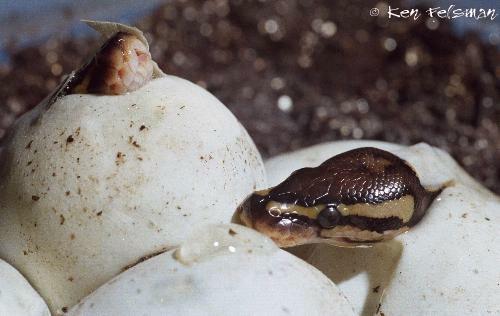
warm ten gallon tank. Typically within 24-48 hour of pipping the baby snakes have absorbed
the egg yolk, and decide to fully emerge from the egg. A week or ten days later the babies
will have their first slough. A week or so after the shed you should start trying to get
them to eat.
Common
Questions and Problems In no particular
order
Q: How warm/what temperature should I keep my
snake at?
A: I suggest heating one end of the tank to about 85-90F, and let the
other side be at 75F. Provide a hide box on either end.
(Housing)
Q: How much humidity does my python need?
A: It should have an area (hide box) which is around 70-80%. Don't
let the cage get much below 60%.
(Housing)
Q: What should I feed my snake?
A: An appropriate sized rodent. Rats are nutritionally a little better than mice,
and gerbils are almost always a winner for a finicky eater.
(Feeding)
Q: Why is my snake's belly getting pink?
A: It's just beginning a 7-10 day shed cycle. You will soon notice
the eyes beginning to get hazy.
(Husbandry)
Q: How often should it poop/defecate?
A: It depends on how much you are feeding your snake and it's metabolism.
You should expect it to "go" at least every 4-6 weeks. If you are
worried, a luke warm/cool bath in shallow water should help.
(Husbandry)
Q: How often should it shed?
A: Young growing snakes shed about once every 4-6 weeks. Adults may only shed a
few times a year.
(Husbandry)
Q: How often should I feed my Ball Python?
A: For the first two-three years (18-36 inches), I would suggest an
appropriate size meal every 7-10 days. My adult males eat good sized meals about every 3
weeks, adult (breeding) females every 2-3 weeks.
(Feeding)
Q: What's the best substrate for my Ball Python.
A: AVOID cedar at all costs! I prefer newspaper...Aspen, Pine,
Cypress, AstroTurf, and Paper towels are also pretty acceptable.
(Housing)
Q: How do I get rid of mites?
A: There are a few good commercial products on the market. I have had luck using Pro-Zap.
Provent-a-Mite from Pro Products is also supposed to be pretty good. The following link will
take you to an informational page about
The War Against Snake Mites. You will find another good article on Pythons.Net (off site)
Q: What's the best way to heat my snakes cage?
A: AVOID "hot rocks" at all costs! I use either under tank heating
pads or clip lamps with aluminum reflectors to heat one end of the cage.
(Housing)
Q: Is a hide box necessary?
A: Absolutely! Ball Pythons need a hide box to feel secure.
A stressed snake won't eat.
(Housing)
Q: How long do Ball Pythons live?
A: Depends on a lot of factors, but you can reasonably expect somewhere
between 20 and 40 years.
(Natural History)
Q: What does 1.2.1 mean?
A: It's simply an abbreviation for gender ratio of snakes (Male.Female.Unknown).
1.2.1 means one male and two females, and one of which the gender is in question.
Q: Why won't my snake eat?
A: Stress is typically to blame... Don't get too worried as long as
your snake isn't loosing a lot of weight. A 6-8 month fasting period
is not unheard of. I hear the record is something like 22 months without food!...
A gerbil is typically pretty tempting to a finicky eater.
(Feeding)
Q: How big will my snake get?
A: Adult Ball Pythons are usually a little over one meter long, that's 36
- 48 inches in American measurement. A really large python can get up to 60 inches.
(Natural History)
Q: Are Ball Pythons good "beginner" snakes?
A: Generally yes, They are usually pretty docile, stay small,
and are somewhat hardy. Though they can be a challenge at times. Other good beginner
snakes are North American Kings (Florida and California) Lampropeltis getula and corn
snakes Elaphe guttata ssp.
(General Information)
Q: How big of a cage does my Ball Python need?
A: A ten gallon tank (20x10x12 inches) is fine for a snake smaller
than 24 inches. An absolute minimum tank for an adult would be a
long twenty gallon tank (30x12x12 inches), though a thirty gallon (36x12x18
inches) would be preferred.
(Housing)
Q: Does my Ball Python need ultra violet light?
A: No, Ball Pythons are nocturnal× and won't significantly
benefit from UV light.
(Housing)
Q: Why did my snake regurgitate/throw up?
A: It could be that you are keeping it too cold, handling it too soon
after a meal, or it could be an infection and/or internal parasites.
If you think it's the latter, take it to a qualified reptile veterinarian.
(Husbandry)
Q: Is it Ok to keep more than one snake in a cage?
A: Yes and No. I don't advise keeping different types/species
and/or sizes of snakes in one cage. After a 2-3 month quarantine, two or more
Ball Pythons of similar size can be house together in a big cage. If they happen to stop
feeding, I would suggest separating them to individual cages, and you'll want to
separate them at feeding time.
(Husbandry)
Q: Why is one of my snake's eye silver?
A: It's most likely a retained eye cap from a previous bad shed, sometimes a damp
cloth will help loosen and remove eye caps. Some people have had luck using a little baby
oil to soften and remove eye caps.
(Husbandry)
Q: Can I safely refreeze rodents?
A: Yes as long as they are not too 'gamey' or rotten. Snakes
in the wild are opportunistic and will eat carrion. One of my Ball Pythons actually
shows a preference for rodents that have been frozen/thawed twice.
(Feeding)
Q: What's the difference between Captive Hatched [CH] and Captive Bred [CB]?
A: Captive Hatched means the eggs were taken from a wild female and
incubated. Captive bred means that someone took the time to induce
a male and female snake to get together, in captivity, and make eggs. CB is much more
preferable.
(General Information)
Q: How do I help my snake with shedding problems?
A: Typically increasing the humidity of the cage and/or hydration of
the snake helps a lot.
(Husbandry)
Q: How large of a meal/rodent can my snake eat?
A: I try and feed my snakes meals which are no larger than twice the
diameter of the snake's head. A hatchling python can safely eat a small to average sized
mouse. An adult can eat a rat which is five or six inches from nose to butt.
(Feeding)
Q: How much should I pay for a Ball Python?
A: Cost depends on where you get it. I would not pay any more than
$50 or $75 to buy one from a pet store.
(General Information)
Q: Oops, my snake escaped! What now?
A: Search at night, look in sofa cushions, closets, and also look on/around appliances
which give off heat... refrigerator, oven, water heater, VCR, TV, etc.
(Husbandry)
Q: Should I be feeding live or dead rodents to my snake.
A: Dead food items are preferred since a dead rodent can't harm or scar your
snake.
(Feeding)
Q: I left a live mouse/rat in the cage over night and it chewed on my
snake?!
A: Call it a learned lesson and don't do it again. To help the
snake during the healing process you may want to increase the heat a little,
and apply a topical antiseptic ointment (like neosporin).
(Feeding)
Q: My snake ate the mouse backward?!
A: Don't worry, sometimes with smaller food items, snakes will eat
from the tail end of the rodent.
Q: What are the signs of a respiratory infection?
A: Clear fluid coming out of the nostrils and/or mouth, wheezing or
popping as it breathes, and/or open mouth breathing. Increase the heat and get it to
a qualified vet as soon as you can.
(Husbandry)
Q: Will my Ball Python bite?
A: Ball Python's typically don't bite, but it can happen.
It doesn't hurt much. (My playful 72 lbs. boxer has accidentally hurt me a lot
worse :) Snakes either bite in defense or as part of the feeding
process. Assuming it's not on your face, just wash the bite and use
an antiseptic ointment (like neosporin).
(General Information)
Q: My snake yawned! Is it all right?
A: Yes, snakes usually yawn to re-align their jaws after a meal.
Ball Pythons sometimes do it for no particular reason.
Q: Is force feeding a good idea?
A: No!...NO! It's stressful for you and the snake. There are
better ways to entice a snake that doesn't want to eat.
(Feeding)
Q: Should I be worried about Salmonella?
A: Well, Most eggs laying animals can/do carry salmonella. There are a few guidelines to
follow that should help. 1) Keep your snake out of the kitchen and away from anything that
goes into your mouth (ex. your fingers, a drinking glass, etc.). 2) Wash your hands after
you've handled your snake. 3) Keep your snake away from anyone who may have a depressed
immune system (babies, elderly, etc.). Steve Grenard has a good page on
salmonella (off site).
Q: Can snakes swim?
A: Yes, snakes are very agile swimmers, as well as being skilled climbers.
(Housing)
Q: Should I give my snake a vitamin supplements?
A: No, snakes eat whole animals that are pretty adequate as nutritional packages. You may
consider supplementing a little calcium into a gravid (pregnant) female's diet, to help with
egg production.
(Feeding)
Q: My snake has been soaking in it's water dish for a day or two, is this normal?
A: Well it can just be that the snake wants to be there. It can also be a sign of mites.
Check for small specks moving around on the snakes body and near it's eyes.
(Husbandry)
Q: Why is my Ball Python hissing?
A: When some snakes feel the need to defend themselves they will puff up and expel air
with force, which causes a hissing sound. This is a snake's way of warning you to leave it alone.
With time, your snake will settle in and learn that you are not a threat to it.
Q: Do Snakes drink?
A: Yes, most of the water a snake needs it gets from the prey item. Though snakes will on
occasion drink. If you are lucky enough to see it happen, it'll usually be right after it eats.
Q: What's that white "chalky" material?
A: Most snakes have evolved to be very efficient with body fluids. They don't urinate
(or pee) like you and I, their kidneys pass 'dry' urates.
Q: Is there a certain time of the day that it's better to handle my snake?
A: Once you've had the snake for a while, it doesn't matter much. For a new snake, it's
probably better to interact with it during the late evening. Ball Pythons are nocturnal and
some might be a little more accepting of disturbance at night, during their normal waking hours.
Q: Help, My snakes eye has a dent in it!
A: Don't panic. This occasionally happens and can be attributed to the snake being a
little dehydrated. Make sure it's got fresh water and a bowl that it can soak in. The dent
should be gone with the next shed cycle.
× Vocabulary
Blister Disease: is an infection, usually seen as red/puss filled blisters on the belly. It is
typically caused by unclean conditions. If you suspect your snake has blister disease,
seek the help of a qualified reptile veterinarian.
Captive Bred: snakes are ones that come from parents who have been in captivity and
the care giver has taken the time to induce the male and female to breed. These are
typically more desirable in that they acclimate better to captive conditions, and that it
has less of an impact on wild populations.
Captive Hatched: snakes are babies which come from eggs that were taken from wild
mothers and incubated.
Crepuscular: refers to animals which rest during the extremes of the day (ie. noon
and midnight) but are active in the morning and evening.
Diurnal: refers to animals which are active during the daylight hours and rest when
it's dark.
Ectoparasite: are external parasites that you will see crawling over, or on, the snake's
body. Mites which are about as big as a period [ . ] and Ticks which are about as big as a
zero [ O ], are the two most common you will see.
Endoparasites: are internal parasites. If you have a wild caught Ball Python, a
veterinarian will be able to find eggs or the parasites themselves in your snakes feces (poop),
by looking at it under a microscope.
Heat Mat: can either be human type heating pads set on low, or plastic ones specially
made for animal applications. The plastic ones typically don't have any way of adjusting
the heat output. What I like to do is add lamp dimmers which snap
onto the cord. This at least gives you a high/low/off setting.
Heat pits: are part of the Ball Pythons group of senses.
They are located on the upper 'lip', and a few are on the back of the lower 'lip.'
Scientists believe they can see heat with these pits in the form of infra-red light.
It's like having a pair of night vision goggles. You will also notice the snake in the
picture is partially blind and has cataracts as a result of previous trauma to it's eye.
Hemostats: are about 6-10 inch long 'tongs' that can be
used to offer food items to snakes without getting your hands too close. You can find them
in some hardware stores, medical supply retailers, and hobby stores.
Herpetoculture: is the hobby of keeping and breeding reptiles and/or amphibians.
Herpetology: is the scientific study herptiles.
Herptile: Refers to either a reptile or amphibian.
Hide Box: a retreat for your snake to feel secure. I use either Terra Cotta pots, or
Rubbermaid tubs with holes in them. I suggest having at least two per cage. One on the warm
end(~88F), and one on the cooler end (~75-78F).
Husbandry: The business or occupation of a husbandman or farmer; tillage or
cultivation of the soil (including also the rearing of live stock and poultry,
and sometimes extended to that of bees, silkworms, etc.); agriculture,
farming.
Hygrometer: is a humidity gauge. Most Wal-Mart/K-Mart type stores sell them for
about $5 in the outdoor/garden section.
Jacobson's Organ: is the sensor located in the roof of a snake's mouth. They take particles
out of the air with their forked tongue, and the Jacobson's Organ interprets these particles
and tells the snake a little about it's environment.
Mouth Rot: is an infection in the oral cavity. Typically caused by unclean conditions
and/or trauma to the mouth. Usually appears as a white cottage cheese like material, or dry
scabs in/or around the mouth. Seek the help of a qualified veterinarian.
Nocturnal: refers to a propensity to rest during the day and be active at night.
Savanna: habitat composed of flat ground with a mixture of trees and tall grasses.
Snake Hook: is a device used to control and/or lift a snake without handling it. You
can make one for a few dollars. Most hardware stores sell metal bar/rod stock in three foot
lengths. For smaller snakes 1/4 or so works good, for larger you can use 3/8 diameter.
Using a bench vise and a hammer, bend one end over onto itself at about the four inches
from the end, this end becomes the handle. At about the four inches from the other end, put
about a 90 degree bend in it. You now have a snake hook for about $4-5.
Quarantine: A period during which persons or animals who might serve to
spread a contagious disease are kept isolated from the rest of the community. Also,
a period of seclusion or isolation after exposure to infection from a contagious disease
|