Emerald Tree Boa - Comparison
with the Green Tree Python
By Paul Huang,
as originally posted on The Emerald Tree Boa Page
Introduction
The emerald tree boa and the green tree python (Morelia viridis) are remarkeably similar. They are easily mistaken for each other even by experienced herpetologists. Below are examples of juveniles and adults of both species. Judge for yourself how similar they are.
Emerald Tree Boa
(Corallus caninus)
Juvenile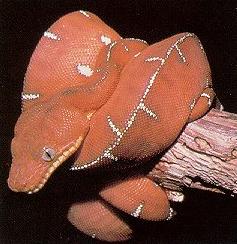
|
Green Tree Python
(Morelia viridis)
Juvenile
Image Courtesy Dave Barker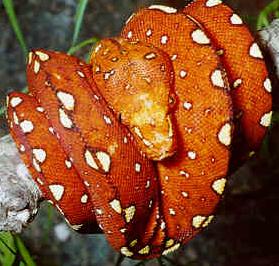
|
Emerald Tree Boa
(Corallus caninus)
Adult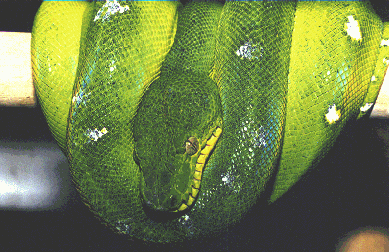
|
Green Tree Python
(Morelia viridis)
Adult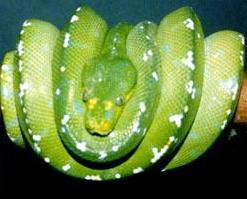
|
Habitat:
Lowland and tropical rain forests
Coiling:
Coil so that the head is more or less in the center of the coil
Color:
various shades of green
Neonate color:
Can be red, orange, yellow, green or a combination of these colors
Heat Receptors:
Present
Size:
4' - 9'
Prehensile Tail:
Present
Teeth:
Presence of long maxillary teeth
|
Habitat:
Lowland and tropical rain forests
Coiling:
Coil so that the head is more or less in the center of the coil
Color:
various shades of green
Neonate color:
Can be maroon, red or yellow
Heat Receptors:
Present
Size:
4' - 6'
Prehensile Tail:
Present
Teeth:
Presence of long maxillary teeth
|
Distribution:
northern South America
Subfamily:
Boidae
Method of reproduction:
ovoviviparous
Number of young:
3 - 15
|
Distribution:
Indonesia, Malaysia, Western Australia
Subfamily:
Pythonidae
Method of reproduction:
oviparous
Number of young:
10 - 25
|
|
Sponsored Link
New & Updated Business Listings
Looking for a reptile or amphibian related business? A reptile store, breeder, importer,
maunfacturer or supplier? Our business directory lists some of the most popluar herp businesses in the world.
| Locate a reptile or amphibian business by name:
|
|
KINGSNAKE.COM
Enjoy all our content free of charge with a user account that gives you full access to every feature.
For added visibility, paid options are available - post in our Classifieds, showcase your business with
Banner Ads or a Directory listing, promote reptile events, and more.
|
Quick Links
|
Community
|
Legal & Safety
|
Support
|
|
|
Kingsnake.com ® is a registered trademark © 1997-
|
|
|