- Scarlet Kingsnake
- Lampropeltis triangulum elapsoides
- Size:
- Hatchling: 5 - 7 in.
- Adult: 14 - 20 in.(normal) 27 in.(record)
- Scalation:
- Dorsal: 17 - 19 near mid body
- Ventral: 152 - 194
- Sub caudal: 32 - 51
- Infra labial:7 - 10
- Supra labial: 7
- Anal Plate: Single
|
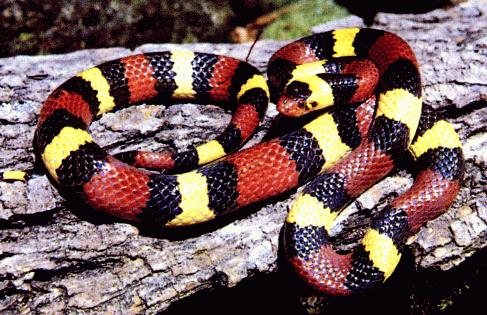
Photo courtesy Martin Schmidt
click to enlarge |
Written by Gerald Keown
- Coloration:
- Head:
Red head with a black line across the posterior portion of the parietals.
- Dorsal:
Normally has 12 - 22 red rings, alternating with yellow and black.
This little snake is a mimic of the Eastern Coral Snake (Micrurus
fulvius fulvius) which also occurs throughout the same range. The
Scarlet Kingsnake always has a red snout with the yellow rings being
seperated from the red rings by black. In the Coral Snake, the snout
is black and the yellow and red rings touch. In the northern portion
of their range, specimens tend to have narrower yellow rings than
those animals found further south. Some specimens from southern
Florida exhibit wider black rings, sometimes even bridging the red
rings dorsally.
- Ventral:
The red, yellow and black ringed pattern normally crosses the belly.
-
- Behavior:
- A small nocturnal kingsnake that is seldom found in the open except
at night after heavy rains. It is very secretive and is most commonly
found beneath logs and bark. .
The temperment of Scarlet
Kingsnakes varies, but most tend to be very nervous little animals, quickly
assuming a defensive posture when distrubed. While they generally
appear to adopt well in captivity, anyone keeping them should be
forewarned - they are true excape artists. In captivity, they are
best maintained on a substrate of pine bark or cyprus mulch and should
be provided some type of hide box. There is one record of a Scarlet
Kingsnake living for 21 years in captivity (Bowler, J.K. 1977.
Longevity of Reptiles and Amphibians in North American Collections.
Soc. Stud. Amph. Rept. Misc. Publ. Herpetol. Cicr.(6) 1-32).
- Breeding:
- Scarlet Kingsnakes are rather easy to breed in captivity; however,
few people seem to breed them, probably due to the small size of the
neotates. Scarlet Kingsnakes need a winter brumation period of 2 to 3
months at 55 - 65 degrees F, if they are to be sucessfully bred.
Breeding usually takes place in April or early May with 2 - 6 eggs
being laid in May or June. The incubation period for the eggs is 52
to 57 days.
- Range:
- South Central Virginia southward to Key West, Florida and westward to
the Mississippi River. The species is more abundant along the Coastal
Plain but has been collected inland at altitudes of almost 2,000
feet. Specimens from Florida seem to
reach greater length that do those found further north.
- Habitat:
- It prefers wooded areas containing pine
trees. This species is frequently collected during March and April in
decaying pine stumps just above ground level. The author once found
three of these "living jewels" under the bark of a single rotten pine
stump only inches apart. When searching for Scarlet Kingsnakes in
this type of habitat, collectors should excerise great care not to
destory habitat. One collector in Mississippi has told the author of
carefully removing the bark from pine stumps and collecting these
animals, then replacing the bark around the tree holding it in place
with twine, only to return each of the following years to find more of
these "jewels" in the same stump.
- Prey:
- Food typically includes lizards, other small snakes, baby mice, earthworms and possibly other insects. Lizards appear to be the
preferred food, especially skinks.
-
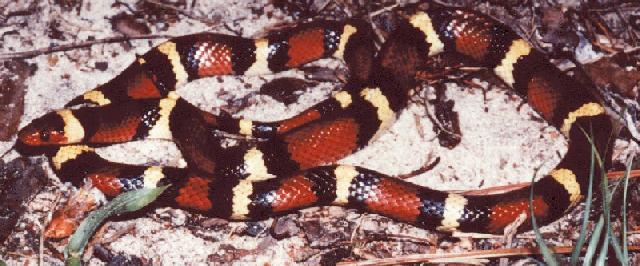
Photo by Troy Hibbitts
Click to Enlarge |

Photo by
Click to Enlarge |
|
|
Sponsored Link
New & Updated Business Listings
Looking for a reptile or amphibian related business? A reptile store, breeder, importer,
maunfacturer or supplier? Our business directory lists some of the most popluar herp businesses in the world.
| Locate a reptile or amphibian business by name:
|
|
Recent Milk Snake Forum Forum Posts
• hypo-e pumpkin Sinaloan milk, posted by sballard
• What's getting paired this year?, posted by AaronBayer
• I'm here, too!, posted by Sunherp
• Kingsnake lives!, posted by exposito
• Hey Everybody, I'm here., posted by AaronBayer
• Scott Ballard Provided A Wealth Of Info, posted by Ameron
• Central America Milksnake Dilemma, posted by Ameron
• Retun to Forum / New Stuart's Milksnake , posted by Ameron
• Eggs ok?, posted by highley1980
• Splotched Sinaloan Variety, posted by bslugger551
• Splotched/Bullseye Sinaloans, posted by bslugger551
• Is my milk snake is getting TOO HOT?, posted by darbellah
• New owner looking for advice, posted by Irishfran
• New adoption biting and chewing fingers, posted by ajcur17
• Help*** Our milksnake won’t eat., posted by KieranSnake
Recent Milk Snake Classifieds:
- Black Milk Snake Male 20...
- 11 Stuarts Milks 2025
- Two Male Vanishing Patte...
Banner Pool
KINGSNAKE.COM
Enjoy all our content free of charge with a user account that gives you full access to every feature.
For added visibility, paid options are available - post in our Classifieds, showcase your business with
Banner Ads or a Directory listing, promote reptile events, and more.
|
Quick Links
|
Community
|
Legal & Safety
|
Support
|
|
|
Kingsnake.com ® is a registered trademark © 1997-
|
|
|