Choosing a Sand Boa
There are two questions to answer in choosing a sand boa:
- Wild-caught or captive born
- Which species is right for me?
Wild-caught vs. Captive Born
The first issue when choosing a Sand Boa (or any other herp) is whether to get a captive born baby or a wild caught adult or
subadult. Aside from the personality issues (wild caught snakes can have unpredictable temperaments) there is the
issue of general overall health. You can usually assume a captive born snake will be free of parasites, scars, and
diseases. This assumption cannot be made about wild caught animals.
Another argument made for buying wild caught adults or subadults is that you don't have to wait for them to grow up to breed
them and you will get offspring sooner. This is NOT true. Most people experienced with Boid snakes have
found that it usually takes 4-5 years for a captive import to settle down to be a
predictable breeder. In that
period, you can raise and breed a captive born snake. The following figure illustrates this point.
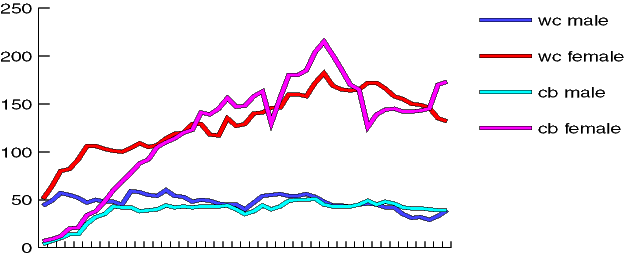
These are the monthly weights of two pairs of Eryx miliaris. One pair was captive born and the
other were imported as subadults. The sharp dips in the weights of the captive born female represent births.
The wild caught snakes never did reproduce during this three and one-half year period. The flat line at
the beginning of the graph represents the difficulty I had getting these cb snakes to eat at first. Once they
started however, you can see how quickly they grew. Notice also that the males did not grow significantly after
reaching sexual maturity. For more information on the differences in growth rates, see the breeding
page.
Which species is right for me?
I answer a lot of email from people wanting to know which species of Sand Boa would be the best for them to start out with.
My answer is always that it depends on a lot of different things. The table further down this page
compares erycine species for the following important considerations:
- Coloration
- while beauty is certainly in the eye of the beholder, some species have brighter colors than others
- Temperament
- Some species are always docile
- others are more unpredictable and prone to individual "personality quirks"
- Female Size
- I include here the average size of an adult female. Males are usually much smaller
- Feeding
- what the adults will eat in captivity
- Feeding Newborns
- what newborns will eat in captivity and how easy it is to get them started
- Availability
- availability of captive born snakes here in the US
- Price
- general price range for captive born babies in the USA
- low = US$75 or less
- medium = US$76 to US$124
- high = US$125 and higher
The following table is intended to compare these characteristics for each species of snake covered on this page.
| Species |
Color |
Temperament |
Female Size |
Feeding |
feeding newborns |
availability |
price |
| colubrinus |
black on orange/yellow |
usually docile- a few are snappy |
30 inches |
mice |
pink mice - easy |
abundant |
low |
| conicus |
gray/yellow/brown |
docile to snappy |
30 inches |
mice |
pink mice - easy |
common |
low |
| elegans |
gray/white |
unknown |
18 inches |
fuzzy mice |
unknown |
none? |
??? |
| jaculus |
brown on tan |
usually docile |
24 inches |
fuzzy mice |
pink mice -tricky |
uncommon |
low |
| jayakari |
black on orange/yellow |
docile |
16 inches |
pinkies |
small lizards? |
uncommon |
high |
| johnii |
brown |
docile |
40+ inches |
mice or small rats |
pink mice - easy |
common |
medium |
| miliaris |
brown on tan |
docile (aggressive feeding response) |
30 inches |
hopper mice |
pink mice - fair |
uncommon |
low |
| muelleri |
black on orange/yellow |
docile |
24 inches |
fuzzy mice |
|
limited |
high |
| somalicus |
brown on tan |
unknown |
unknown |
unknown |
unknown |
none |
??? |
| tataricus |
brown on tan |
usually docile |
40 inches |
mice or small rats |
pink mice -fair |
uncommon |
low |
| Lichanura |
brown/pink/orange on white/gray |
docile |
40 + inches |
mice + |
pink mice -easy |
abundant |
low to high |
| Charina |
brown |
docile |
30 inches |
small mice |
pink mice -fair |
uncommon |
low to medium |
| Calabaria |
pink on brown |
docile |
40 inches |
small mice or rats |
pink mice -easy |
rare |
high |
© Chris Harrison
September 1999
|
Sponsored Link
New & Updated Business Listings
Looking for a reptile or amphibian related business? A reptile store, breeder, importer,
maunfacturer or supplier? Our business directory lists some of the most popluar herp businesses in the world.
| Locate a reptile or amphibian business by name:
|
|
KINGSNAKE.COM
Enjoy all our content free of charge with a user account that gives you full access to every feature.
For added visibility, paid options are available - post in our Classifieds, showcase your business with
Banner Ads or a Directory listing, promote reptile events, and more.
|
Quick Links
|
Community
|
Legal & Safety
|
Support
|
|
|
Kingsnake.com ® is a registered trademark © 1997-
|
|
|