- San Pedro Mountain Kingsnake
Baja California Mountain Kingsnake
- Lampropeltis zonata agalma
- Size:
- Hatchling: 8 - 11 in.
- Adult: 24 - 44 in..(normal)
- Scalation:
- Dorsal: 21 - 23 rows
- Ventral: 190 - 220
- Sub caudal: 50 - 56
- Infra labial:9
- Supra labial: 7
- Anal Plate: Single
|
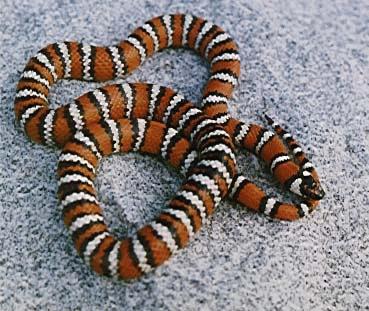
click to enlarge
Photo Courtesy Kirk Setser |
Written by Paul Lynum
- Coloration:
- Head:
Variable. Usually a black head a big block of red with white mixed in. Some have only little spots of red or some with little spots of white. Specimens from the south tend to have alot more red on the
head. Some up to 95% with very little black at all.
- Dorsal:
A snake with a range of 32- 56 triads with a average of 43. Depending on range, in the north a bright clean white with pumpkin orange. Dark orange is occasionally seen. Black cross
overs vary as well. Anywhere from no cross overs to an almost entirely black and white snake. In the south, bright orange with very little black cross overs.
- Ventral:
The ventral on the animals from the north part of the range tend to have complete rings with a little more checker boarding between the band The southern snakes tend to have a cloudy pinkish white stripe running down the length of the ventral on the snake. Very seldomly do the bands complete on the ventral.
- Range:
- The Sierra Juarez and Sierra San Pedro Martir Mountains of Baja California Norte, Mexico
- Habitat:
- Elevations range from 4500-7000 feet. Habitat starts at the upper elevation chaparral to the transition zone of pine into pine forest of pinyon pine, coulter and Jeffrey pine. Scattered sunlit rock out crops are preferred but sometimes found in rotted stumps and logs.
- Prey:
- In captivity, they readily feed on lab mice and rarely prefer lizards. In the wild, western skinks and Western fence lizards. Rodents and other snakes are most likely not fed upon.
- Behavior:
-
A snake mostly restricted of little to big sized rock outcroppings with underground access. In the middle of march they come out of hibernation and travel trough the rock fractures in the boulders up to the surface and thermoregulate under rock flakes. Around the beginning of May when temperatures are warmer, they will move short distances from the rocks in search of food and mates. As spring progresses into summer, they become nocturnal but not moving far from their rock homes. As summer turns in to fall, they move back underground not to come up again until the following spring.
- Breeding:
-
In the wild breeding occurs from the end of April till the middle of June. Eggs are laid sometime in July and August hatching in September and October. In captivity I have had my success by the doing the following. In the beginning of October shutting of all food. I keep the temperature about 82 F. Keeping them warm will help the digestive track clean out. About the first or second week in November I drop the temperature 5 degrees everyday until 50 F is reached. During this period the snakes will be kept in complete darkness. February 15 and the lights come back on and the temperature is brought up 5 degrees a day till 75 F is met. The males are fed one mouse a week and depending on size of the females, feed 2-3 mice a week. I put the female in with the male at the end of March. The females usually show signs of eggs a few weeks later. I put in a nest box after a pre-egg laying shed. After a clutch of 3-9 eggs(5 average) have been dropped, put them in a plastic shoebox with moist vermiculite. Eggs should be kept at about 80-85 F. Hatching takes about 60-80 days. When the female has finished laying her eggs, feed her 4-6 mice a week until she is back to her normal self. Do not get her to obese.
- Literature Cited:
- Stebbins,Robert C. 1985 second editition revised. A field guide to Western
Reptiles and Amphibians. Houghton Mifflin Company
- Lynum, Paul J. Unpublished natural history notes on Lampropeltis zonata
|
|
Sponsored Link
New & Updated Business Listings
Looking for a reptile or amphibian related business? A reptile store, breeder, importer,
maunfacturer or supplier? Our business directory lists some of the most popluar herp businesses in the world.
| Locate a reptile or amphibian business by name:
|
|
Recent Mountain Kingsnakes Forum Posts
• Desert king, posted by kcaj
• Desert king, posted by kcaj
• Desert king, posted by kcaj
• Arizona mnt king, posted by kcaj
• Zonata ownership in Ca?, posted by steeve111
• Zonata, posted by mountain-kings
• photos, posted by mountain-kings
• no new posts, posted by mountain-kings
• Ring counts for pyros, posted by emoryi
• Breeding size for Arizona Mountain Kings, posted by 4dnospolk
• incubation time approx., posted by kcaj
• Santa Barbara habitat shots, posted by markg
• 2014 pyro, posted by markg
• 2014 CB zonata, posted by Ryan_Sikola
• hi, posted by batgirl25
Recent Mountain Kingsnake Classifieds:
Banner Pool
KINGSNAKE.COM
Enjoy all our content free of charge with a user account that gives you full access to every feature.
For added visibility, paid options are available - post in our Classifieds, showcase your business with
Banner Ads or a Directory listing, promote reptile events, and more.
|
Quick Links
|
Community
|
Legal & Safety
|
Support
|
|
|
Kingsnake.com ® is a registered trademark © 1997-
|
|
|