- Utah Mountain Kingsnake
- Lampropeltis pyromelana infralabialis
- Size:
- Hatchling: 8-11 in.
- Adult: up to 45 in.(normal)
57.75 in.Southern Utah specimens tend to be larger than central
and southern Arizona specimens (Bartholomew, pers. Comm.)
- Scalation:
- Dorsal: 21 - 23
- Ventral: 213 - 230
- Sub caudal: 59 - 79
- Infra labial:10
- Supra labial: 9
- Anal Plate: Single
|
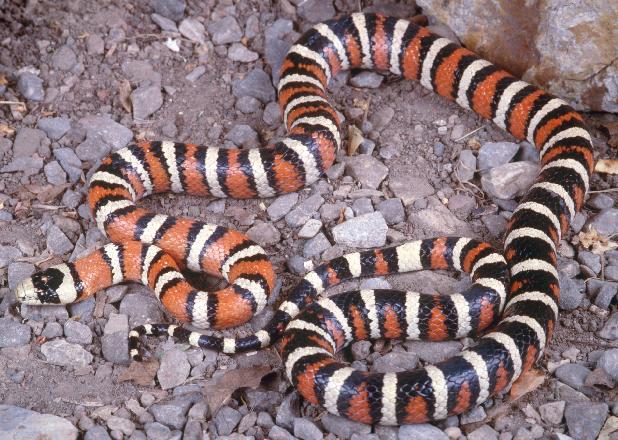
Washington County, Utah
Photo by Breck Bartholomew |
Written by Hans F. Koenig
- Coloration
-
A tri-colored snake with orange or red, white or yellow and black rings.
- Head:
Face is white, with a distinct black mask, the first white
ring encircles the head, starting behind the mask.
- Dorsal:
Generally there are 42 to 57 white rings on the body and 9 to 10 on the tail. Utah specimens are quite variable. In general, they tend to be darker than Arizona specimens and have more black rings that widen across the red rings dorsally (Bartholomew, pers. Comm.).
- Ventral:
Fifty percent or more of the white body rings extend unbroken across the belly (Stebbins, 1966). Infralabials 9-9 (Tanner, 1953).
- Range:
- This subspecies ranges from Arizona north of the Colorado River on the Arizona Strip through central Utah and eastern Nevada where they are confined to Water and Sawmill Canyons in the Egan Range. The author has examined specimens from The North Rim Grand Canyon National Park, Coconino Co., AZ., Mohave Co., AZ., Egan Range, White Pine Co., NV. and Washington Co., UT. Distribution spotty (Stebbins, 1966)
- Habitat:
- Utah Mountain kingsnakes frequent pinyon-juniper woodland and chaparral to the pine-fir belt (Stebbins, 1966). In Utah, they have been found in sagebrush , Ponderosa pine and Douglas fir plant communities (Bartholomew, pers. Comm.). One specimen examined by the author was found at 7,200' Mohave Co., AZ. The habitat was characterized by Ponderosa pine, sagebrush and New Mexico locust. There were no streams or permanent water sources in the area. The area was rocky with extensive south-facing rockslides. Utah Mountain kings have been recorded from 2,800' to 9,100' elevation . They are typically found near water and rocky areas.
- Prey:
- Primarliy lizards and small rodents, they are opportunistic feeders and will probably take nestling birds as well.
- Behavior:
- In his field research on the Utah Mountain Kingsnake, Breck Bartholomew surgically planted tiny radio transmitters in two specimens and monitored their activity. Bartholomew noted that these specimens spent most of their time underground. They preferred relatively cool temperatures: 18-22 degrees C.When basking on the surface, they often remained well-hidden by undergrowth.
- Breeding:
-
Utah Mountain Kingsnakes should be kept like other pyromelana and have no special requirements. Specimens are seldom seen in captivity, due to the fact that they are are protected throughout much of their range. For this reason these beautiful snakes have been relatively unknown in mainstream herpetoculture and little is known of their breeding in captivity or in the wild. Successful propagation probably requires a brumation period of approximately three and a half months.
- Description
- A description of the subspecies Lampropeltis pyromelana infralabialis was first published by Tanner in 1953. Tanner recognized 4 color patterns or subspecies:
L. pyromelana infralabialis, L. pyromelana knoblochi, L. pyromelana pyromelana and L. pyromelana woodini. (Wright & Wright, 1957). Tanner based the classification of the Utah Mountain kingsnake on the 9 lower labial scales in infralabialis compared to 10 in p. pyromelana and the 50 percent or more white rings extending unbroken across the belly (infralabialis) versus 50 percent or less of the white rings extending unbroken across the belly (p. pyromelana). Bartholomew (unpublished data) found that most but not all of the Utah specimens had the distinctive labial scale count. A taxonomic review of Lampropeltis pyromelana may determine the subspecies infralabialis to be invalid.
Until then, this subspecies is still recognized.
- Notes:
-
In recent years, there have been reports of intergrades between L. p. infralabialis and the Utah Milksnake L. triangulum taylori occurring naturally in northern Utah. During his fieldwork, Bartholomew examined some of these reported intergrades and found them to be neither intergrades nor new subspecies. Instead, he concluded that the deviation in patterns exhibited by these taylori and infralabialis was a result of the "edge of range" effect and not from hybridization as had been previously reported. The "edge of range" effect is noted in individuals of a species or subspecies that occupy the outer most extent of their ranges.
Utah Mountain Kingsnakes are state-protected in Utah and Nevada and may not be collected. They are also illegal to collect in National Parks. In Arizona, mountain kingsnakes can be collected outside the boundaries of National Parks and National Monuments with a valid Arizona Hunting license.
- Literature Cited:
-
Bartholomew, Breck. Personal Communication. 1997.
- Stebbins,Robert C. 1966. A Field Guide to Western Reptiles and Amphibians. Houghton Mifflin Company, Boston, MA.
- Wright, A.H. and A.A 1957. Handbook of Snakes of the United States and Canada. Vol. 1. Comstock Publishing Associates. Ithaca, N.Y.
|
|
Sponsored Link
New & Updated Business Listings
Looking for a reptile or amphibian related business? A reptile store, breeder, importer,
maunfacturer or supplier? Our business directory lists some of the most popluar herp businesses in the world.
| Locate a reptile or amphibian business by name:
|
|
Recent Mountain Kingsnakes Forum Posts
• Desert king, posted by kcaj
• Desert king, posted by kcaj
• Desert king, posted by kcaj
• Arizona mnt king, posted by kcaj
• Zonata ownership in Ca?, posted by steeve111
• Zonata, posted by mountain-kings
• photos, posted by mountain-kings
• no new posts, posted by mountain-kings
• Ring counts for pyros, posted by emoryi
• Breeding size for Arizona Mountain Kings, posted by 4dnospolk
• incubation time approx., posted by kcaj
• Santa Barbara habitat shots, posted by markg
• 2014 pyro, posted by markg
• 2014 CB zonata, posted by Ryan_Sikola
• hi, posted by batgirl25
Recent Mountain Kingsnake Classifieds:
Banner Pool
KINGSNAKE.COM
Enjoy all our content free of charge with a user account that gives you full access to every feature.
For added visibility, paid options are available - post in our Classifieds, showcase your business with
Banner Ads or a Directory listing, promote reptile events, and more.
|
Quick Links
|
Community
|
Legal & Safety
|
Support
|
|
|
Kingsnake.com ® is a registered trademark © 1997-
|
|
|