- Desert Kingsnake
Sonoran Kingsnake
- Lampropeltis getula splendida
- Size:
- Hatchling: 7 - 10 in..
- Adult: 36 - 45 in. (record is 60 in.)
- Scalation:
- Dorsal: 23 - 25 near mid-body
- Ventral: 199 - 237
- Sub caudal: 40 - 62
- Infra labial: 9 - 10
- Supra labial: 7 - 8
- Anal Plate: Single
|
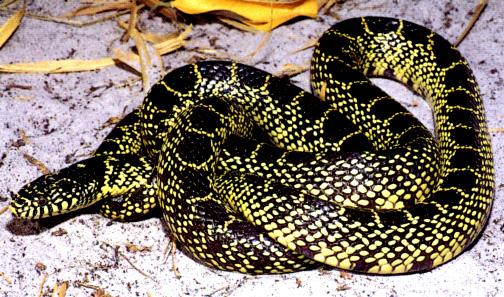
Image courtesy Martin Schmidt
click to enlarge |
Written by Gerald Keown
Coloration:
- Head:
The head is black. The labials are pale colored with wide
vertical lines.
- Dorsal:
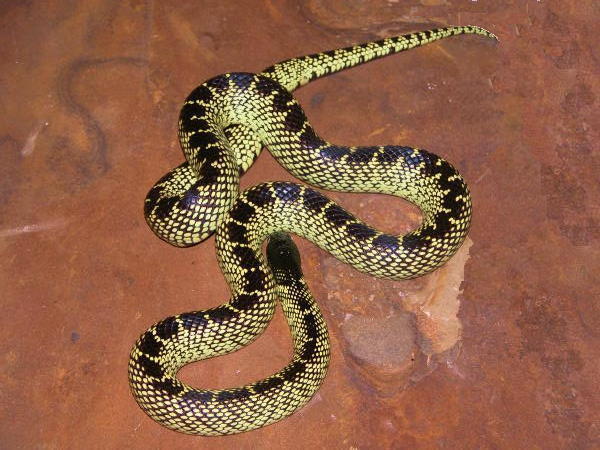
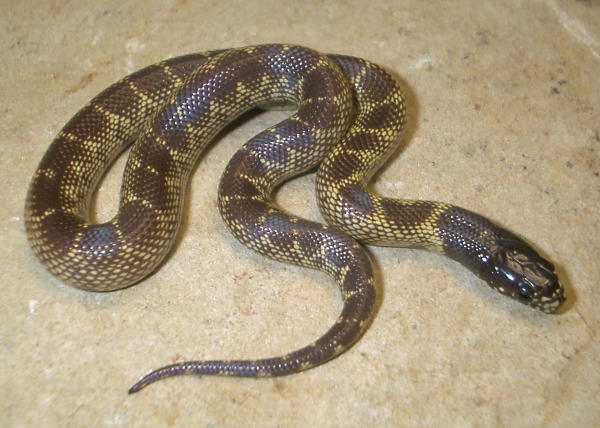
The overall dorsal coloration is dark brown or black. The
lateral scales are heavily speckled with yellow. There are 20 to
42 moderately to poorly defined dark rectangular saddles. These
saddles are seperated by yellow speckled crosslines, 2 to 3
scales in width.
- Ventral:
The belly is essentially black.
Behavior:
A nocturnal species, usually active only during the late
afternoon and evening hours. It is secretive, spending much of
its time hiding beneath logs and debris. When encountered in the
wild it is a very nervous animal, vibrating its tail rapidly and
putting on a valiant defensive display. Recently captured
specimens defecate and discharge a foul smelling musk when
handled. In captivity, most Desert Kingsnakes calm down and do
very well. This species was formerly known as the Sonoran
Kingsnake. Contrary to what both common names would lead you to
believe, this kingsnake is not a true arid land dweller. While
it may occasionally be found in arid areas, it is much more
abundant in Mesquite covered brush land, generally not far from
some source of water.
Breeding:
Breeding occurs during April and May. During June and
July clutches of 5 to 12 adhesive shelled eggs, each measuring
about3/4 x 1 1/2 inches, are laid underground in loose moist
soil. Hatching occurs from late August through early October.
Range:
Central and south Texas westward, across southern New Meico,
to southeastern Arizona, southward to San Luis Potosi and
Zacatecas, Mexico. In Mexico it ranges as far west as Sonora.
It intergrades with Lampropeltis g. holbrooki in eastern and
northern parts of its range and with Lampropeltis g. californiae
and Lampropletis g. nigritus in Arizona and Sonora,
Mexico.
Prey:
The Desert Kingsnake is a powerful constrictor feeding upon
other snakes (including rattlesnakes), lizards, birds and small
mammals. On occasions it has also been reported to feed upon
frogs. It appears to be immune to the venom of native venomous
snakes, upon which it feeds.
Literature Cited:
Conant, R. and J. Collins. 1991. Reptiles and Amphibians of
Eastern & Central North America 3rd edition. Houghton Mifflin Co.
Boston, MA.
Markel, R. G. 1990. Kingsnakes and Milk Snakes. T.F.H.
Publications. Neptune City, NJ.
Tennant, A. 1985. A Field Guide to Texas Snakes. Gulf
Publishing Co. Houston, Tx.
Vermersch, T. G. and R. E. Kuntz. Snakes of South-Central
Texas. Eakin Press. Austin, TX.
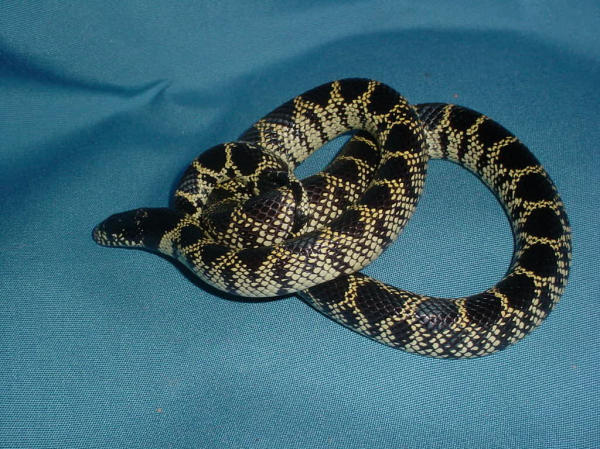
Gallery Photo by DerekB
Click to Enlarge |
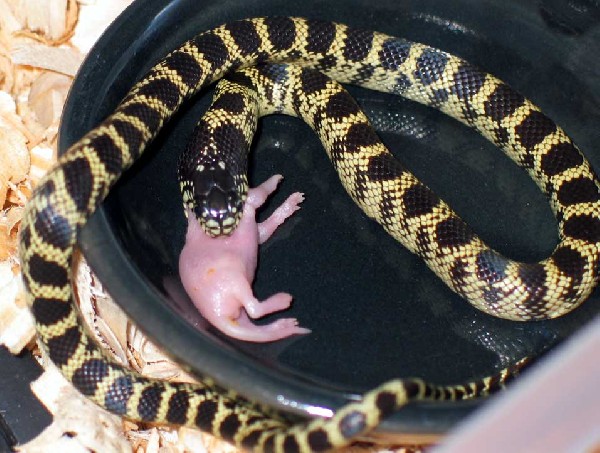
Gallery Photo by Br8knitOFF
Click to Enlarge |
Gallery Photo by Don Shores
Click to Enlarge |
Gallery Photo by Don Shores
Click to Enlarge |
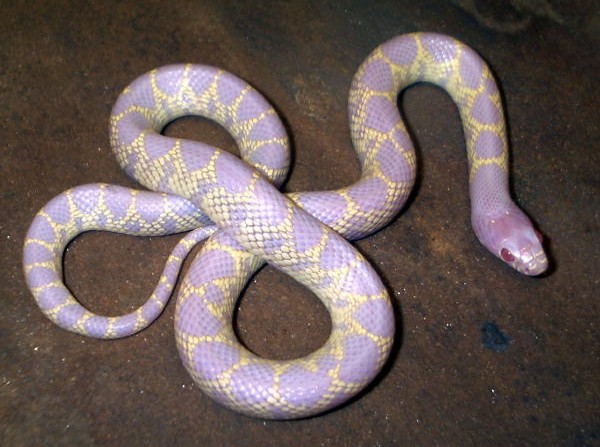
hypomelanistic hatchling
Gallery Photo by Don Shores
Click to Enlarge |
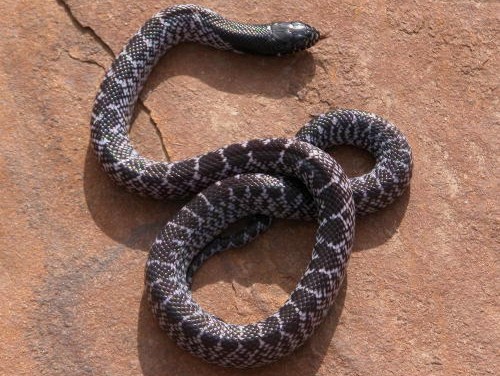
anerythristic or axanthic
Gallery Photo by Don Shores
Click to Enlarge |
|
|
Sponsored Link
New & Updated Business Listings
Looking for a reptile or amphibian related business? A reptile store, breeder, importer,
maunfacturer or supplier? Our business directory lists some of the most popluar herp businesses in the world.
| Locate a reptile or amphibian business by name:
|
|
Recent Milk Snake Forum Forum Posts
• hypo-e pumpkin Sinaloan milk, posted by sballard
• What's getting paired this year?, posted by AaronBayer
• I'm here, too!, posted by Sunherp
• Kingsnake lives!, posted by exposito
• Hey Everybody, I'm here., posted by AaronBayer
• Scott Ballard Provided A Wealth Of Info, posted by Ameron
• Central America Milksnake Dilemma, posted by Ameron
• Retun to Forum / New Stuart's Milksnake , posted by Ameron
• Eggs ok?, posted by highley1980
• Splotched Sinaloan Variety, posted by bslugger551
• Splotched/Bullseye Sinaloans, posted by bslugger551
• Is my milk snake is getting TOO HOT?, posted by darbellah
• New owner looking for advice, posted by Irishfran
• New adoption biting and chewing fingers, posted by ajcur17
• Help*** Our milksnake won’t eat., posted by KieranSnake
Recent Milk Snake Classifieds:
- Black Milk Snake Male 20...
- 11 Stuarts Milks 2025
- Two Male Vanishing Patte...
Banner Pool
Snake Forums
Launched in 1997, the kingsnake.com message board system is one of the oldest and largest systems on the internet. Here you may share and discuss information with others about your favorite reptile and amphibian related topics such as care and feeding, caging requirements, permits and licenses, and more.
Click a link below to visit a forum or a tab above to see more forums.
|
Enter a keyword to search. Search in: |
Search Tips - More - Old forum archives
Snake Forums
Lizard Forums
Launched in 1997, the kingsnake.com message board system is one of the oldest and largest systems on the internet. Here you may share and discuss information with others about your favorite reptile and amphibian related topics such as care and feeding, caging requirements, permits and licenses, and more.
Click a link below to visit a forum or a tab above to see more forums.
|
Enter a keyword to search. Search in: |
Search Tips - More - Old forum archives
More Forums
Launched in 1997, the kingsnake.com message board system is one of the oldest and largest systems on the internet. Here you may share and discuss information with others about your favorite reptile and amphibian related topics such as care and feeding, caging requirements, permits and licenses, and more.
Click a link below to visit a forum or a tab above to see more forums.
|
Enter a keyword to search. Search in: |
Search Tips - More - Old forum archives
Venomous Forums
Amphibian Forums
Turtles & Tortoises
General Forums
KINGSNAKE.COM
Enjoy all our content free of charge with a user account that gives you full access to every feature.
For added visibility, paid options are available - post in our Classifieds, showcase your business with
Banner Ads or a Directory listing, promote reptile events, and more.
|
Quick Links
|
Community
|
Legal & Safety
|
Support
|
|
|
Kingsnake.com ® is a registered trademark © 1997-
|
|
|