The Captive Breeding of Colubrid Snakes:
This document, written by Steven T. Osborne, was originally published as a
4 part series in the 1982 edition ( Volume 4: Number 3,4,7, & 9 ) of the
San Diego Herpetological Society Newsletter.
Part l. A Brief History
In the last 3 to 4 years there has been a concentrated interest in the
captive breeding of North and Central American colubrid snakes. This
activity can now be found in the private, scientific, and institutional
(Zoo) realms of herpetology. The major genera of concentration for this
series will be Elaphe, Pituophis, and Lampropeltis.
There are four major reasons why these genera have been the chosen few.
These are:
- accessibility to wild populations to establish breeding stock;
- ability for wild-caught, as well as captive-born specimens, to adapt and
perform well in captivity;
- the beautiful colors and patterns that many species' groups exhibit;
- the commercial value of captive-born offspring.
|
| In recent years many conservation laws have put strict limitations on the
collecting of many species of snakes. Fortunately, many of the species in
the Elaphe, Pituophis, and Lampropeltis genera were well on their way in
captive breeding situations before these laws were initiated. Much of the
original parentage was collected in the field between 4 to 8 years ago.
The species that people were interested in were usually caught within 1000
miles (often much less) of home, and this created annual pilgrimages to the
collecting grounds. Almost all of these species are relatively abundant
and easily found in their native habitats. Whether or not these collected
specimens would be used for captive breeding depended on the collector. | 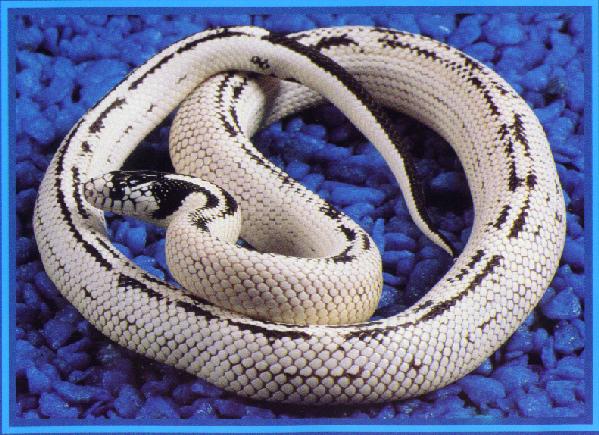
click to enlarge |
|
These three genera have been documented as early as the 1890's for their
ability to adapt to a captive lifestyle. The most common sign for this is
their willingness to feed on the first and second day of Captivity. Most
specimens lock right into an annual breeding performance as manipulated by
the keeper. Perhaps the most dramatic example of domestic adaptation is
the proven ability to raise a female captive-born hatchling to an adult
which lays eggs at 18 months of age. The adult size of these snakes has
also been significant because they require less cage space than larger
constrictors.
Anyone who begins to observe the wide variety of patterns and stark colors
in the Lampropeltis or Elaphe groups can attest to the fact that they are
among the most beautiful of snakes. Many captive breeders have selected
certain snakes, such as the two phases of the California king snake, to
experiment with pattern polychromatism. Very valuable data from behavior,
pattern types, and body morphology is being acquired that will perhaps
redefine the now existing status of relationships within a genus and
between genera. The favorite species among captive breeders are L.
mexicana, L. triangulum, L. pyromelana, and various amelanistic (a
partial albino lacking black pigment) subspecies found in L. getulus, P.
melanoleucus, and Elaphe spp. This is primarily due to the beautiful
display of bright colors on light backgrounds or in ringed patterns.
The commercial sale of captive-produced offspring is becoming a bigger part
of captive breeding. Many amateur herpetologists, as well as institutions,
develop a desire for more expensive specimens. It makes sense to want to
produce commercially saleable offspring to offset the cost of the initial
breeding stock. Many private individuals are looking to the years ahead
when an actual profit can be made. In recent years there has been an
ever-increasing value put on obtaining captive-produced offspring. The
reasons for this are threefold:
- hatchling size is usually the only size obtainable;
- a hatchling is almost guaranteed to be free of any internal parasites;
- the intrinsic conservation value of obtaining a captive hatchling rather than collecting it in the field.
We can look forward to the knowledge of what will be learned from all
aspects of captive breeding of reptiles and amphibians. There should be
many breakthroughs in the next 10 years that will add to our appreciation
of herpetology.
All photos and text courtesy Steven T. Osborne - Professional Breeders
|
 | | |
|
Sponsored Link
New & Updated Business Listings
Looking for a reptile or amphibian related business? A reptile store, breeder, importer,
maunfacturer or supplier? Our business directory lists some of the most popluar herp businesses in the world.
| Locate a reptile or amphibian business by name:
|
|
KINGSNAKE.COM
Enjoy all our content free of charge with a user account that gives you full access to every feature.
For added visibility, paid options are available - post in our Classifieds, showcase your business with
Banner Ads or a Directory listing, promote reptile events, and more.
|
Quick Links
|
Community
|
Legal & Safety
|
Support
|
|
|
Kingsnake.com ® is a registered trademark © 1997-
|
|
|