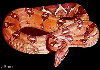
I purchased my first "Orange-Tail" Hypos three or four years ago. I had heard of them before but had not seen them until that time. When
thoughtfully looking them over I realized what made the hypos or what the net effect of being a Hypo was. They have an overall wash involving a
reduction of black pigmentation over the entire Boa. They also have reduced black in the black rings around the tail blotches.
I had been selectively breeding my Boas for many generations already and had primarily selected for one thing in particular that other people
didn't really look for. Most breeders like contrast. I like contrast too but the
Boas I enjoyed most were the babies without contrast because they generally tended to be much lighter and or more colorful than those with great
contrast. I have raised a number of Boas with good contrast in the past and they usually turned quite dark, as they got older. I never liked that. I
wanted ‘em light and or with great color. I was fortunate from the beginning
in that I had acquired a number of animals that had great color already and through breeding them with other nice Boas was able to produce even nicer,
lighter, more colorful babies with each generation. Which brings me back to my revelation.
I was looking over the "Orange-Tail" hypos I had acquired when I realized I had Boas with the same overall reduction in black. In particular, the
blotches on the sides that typically contained black were very washed out in the "Orange-Tail" hypos. Many of the babies I had been producing had this
same characteristic. The blotches on the sides just had far less black than did normal Boas. They also had the overall wash reducing black over the
entire animal. They do not have the large reduction in the rings around the tail blotches like the "Orange-Tail" hypos have nor do they muddy up like
the "Orange-Tail" hypos when they get larger. These Boas, which I named "Pastels", were fairly rare. The trait seems to be a recessive genetic
characteristic which works like skin color in humans. Lighter skin color is a recessive trait but not simple recessive like blue eyes are for instance
to brown eyes. Each generation I have been able to produce slightly more than the previous generation using selective breeding. Occasionally I will
get an unusually patterned "Pastel" which I have kept for myself. I still have not bred a "Pastel" with a "Pastel" so I don’t know yet what will
happen when I do that but it can only get better. The best part about the "Pastel"
characteristic is the reduction in black. One side benefit has been in producing Pastels I have babies with much more color coming through than
most other Boas. Don’t confuse the orange and or pink colors I have produced
with the "Pastel" characteristic that reduces the overall wash of black allowing the underlying colors to come through. Not all Pastels have great
color. Many are just very light and or washed out.
Article compliments of: Jeff Ronne
Photos compliments of: Jeff Ronne